
273a Church St, Onehunga, Auckland, Auckland
By Christopher Green, UP2IT Access Hire · 18 September 2026 · 7 min read
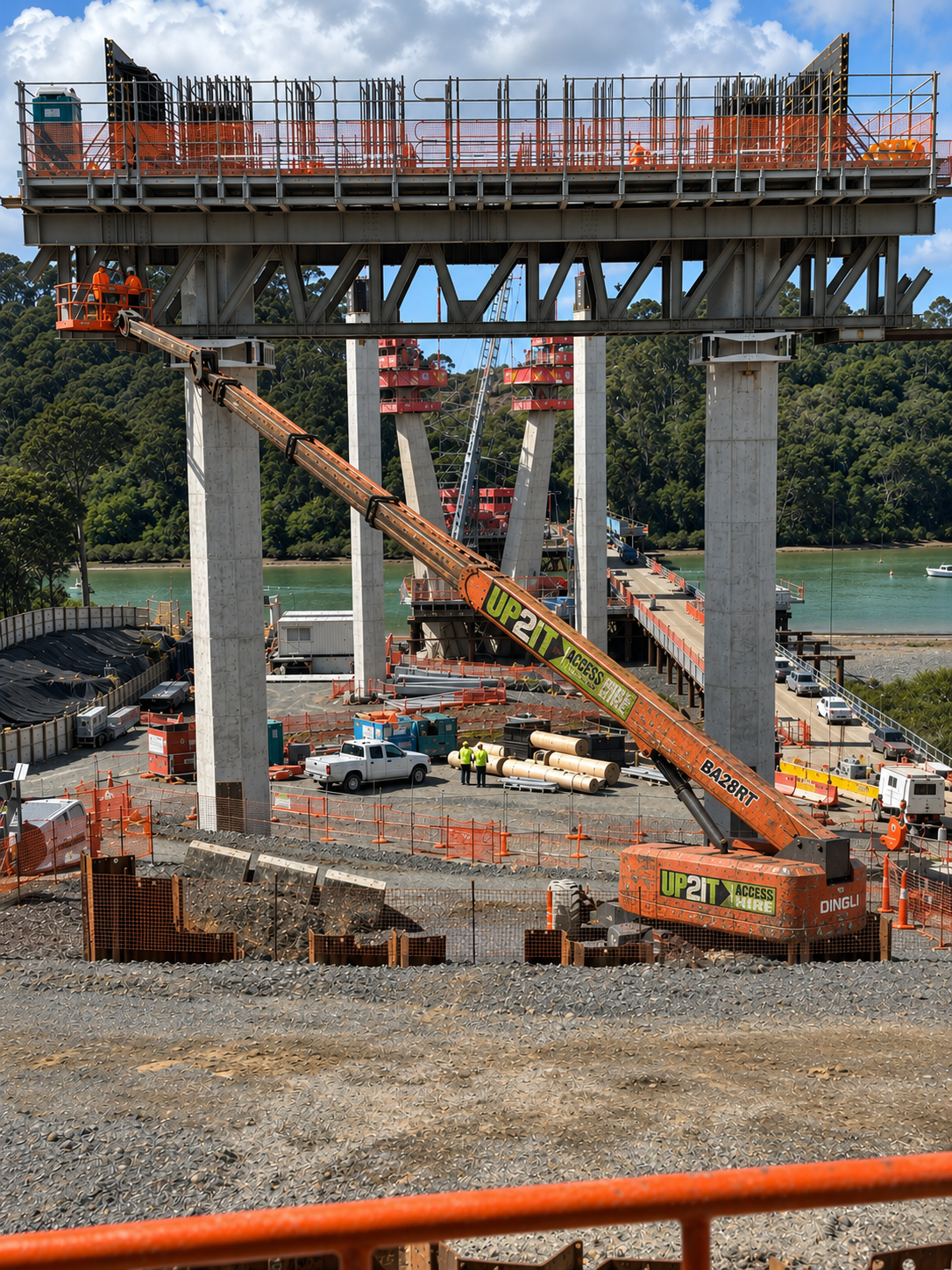
Boom lifts get you higher and further out than any scissor lift, up and over obstacles or across gaps a scissor can’t reach. That reach is also what makes them less forgiving. A boom carries its whole platform load out beyond its wheels, so ground, slope and how you drive matter even more.
The short version
- Pick the right boom: telescopic for maximum reach, knuckle for up-and-over and tight sites.
- Always wear a harness clipped to the platform’s certified anchor point.
- Our booms have no stabilisers. Stability comes from level, firm ground and staying within the slope rating.
- Lower the boom and face the direction of travel when moving between work areas.
- Keep 4 m from power lines and plan a rescue before anyone goes up.
A telescopic (straight or stick) boom extends in a straight line from the turntable. A knuckle (articulating) boom has two or more sections joined by hinges, so it can climb up, fold over an obstacle and reach down or out on the other side.
| Telescopic boom | Knuckle boom | |
|---|---|---|
| Also called | Straight or stick boom | Articulating or up-and-over boom |
| Horizontal outreach | Longest of any boom type | Less outreach, more flexibility |
| Up and over obstacles | Limited | Excellent |
| Working height | Usually the highest | Usually a little lower for the same size |
| Footprint and tail swing | Larger; counterweight swings out | More compact; little or no tail swing on many models |
| Best for | Open sites, reaching in from a distance | Tight or congested sites, reaching over things |
Choose a telescopic boom when you need: maximum height and horizontal outreach, to stay well back from the work (beyond a garden, footpath or loading dock), and fast positioning across open sites.
Choose a knuckle boom when you need: to reach up and over parapets, roofs, pipework or machinery, to work in tight or congested sites, or a compact machine with little or no tail swing.
Not sure which one?
Tell us the working height, how far out you need to reach, what’s in the way and the ground conditions. We’ll match the right machine to the job. We also offer free site inspections to help you make the right decision.
UP2IT booms are self-propelled machines without stabilisers or outriggers. They stay upright through their counterweight, the width of the chassis and level, firm ground. There’s nothing to level the machine for you, so the ground does all the work.
Know the slope limits
Lifting: booms are only rated to work on a small slope, typically <5° for many self-propelled booms. The exact figure for your machine is on the decals and in the manual.
Driving: a machine’s gradeability (the slope it can climb stowed) is much steeper than its working slope. Never confuse the two.
Tilt alarm: if it sounds, stop. Retract and lower the boom straight away. Don’t try to drive or slew your way out of it.
Harness on, every time
WorkSafe requires operators of boom-type lifts to wear, and be trained in the use of, a harness inside the platform, attached to a certified anchor point with a short energy-absorbing lanyard or a suitable self-retracting lifeline that keeps you in the basket. Never clip to the guardrail. UP2IT Access Hire provides training to NZQA unit standard 23229 on the safe use of harnesses at height (EWP Training | UP2IT).
| ✓ Do | ✗ Don’t |
|---|---|
| Stay within the platform capacity for the zone you’re in | Overload the platform or exceed the outreach limit |
| Keep both feet on the platform floor | Climb, sit or stand on the rails |
| Watch overhead and behind you when moving the boom | Use the boom to push, pull or lift loads |
| Move slowly near structures and stop with a clear gap | Use the platform as a crane or attach sheet materials |
| Check the wind speed and the machine’s wind rating | Work above the rated wind speed or in gusty conditions |
| Tether tools and keep the area below clear | Leave the platform elevated and unattended |
The 4 metre rule
Under NZECP 34, every part of the machine must stay at least 4.0 m from a live overhead line unless the line owner gives written consent (NZECP 34 extract). Between 4 and 6.4 m, WorkSafe advises a dedicated safety observer.
A boom’s reach makes it easy to swing into a line you didn’t see. In Auckland, close approach consents come from Vector.
If you touch a line: stay in the platform. If it’s safe, use the controls to move away and break contact. If you can’t, stay put and keep everyone well clear until the power company confirms the line is dead.
Agree a rescue plan before anyone goes up, and make sure your ground person knows the machine.
Print this out or keep it on your phone.
☐ Trained and familiarised on this boom
☐ Pre-start check done, certificate current
☐ Right boom for the job: reach, up-and-over, site space
☐ Ground firm and level, within the slope rating, no voids
☐ Wheel loads checked against slabs, covers and pavers
☐ Tail swing zone and area below barriered off
☐ Harness on and clipped to the certified anchor
☐ Overhead path checked, 4 m from power lines
☐ Wind speed checked against the machine rating
☐ Ground person briefed and rescue plan agreed
Need a boom lift or EWP training?
UP2IT Access Hire supplies serviced, certified telescopic and knuckle booms across Auckland from our Penrose depot, delivered on our own trucks. We run EWP operator training on your site or in our modern classrooms. And if a machine can’t be fixed on site within half a day, we’ll swap it where possible.
This guide is general information only. Always follow the manufacturer’s operating manual, your site safety plan and current WorkSafe NZ guidance.