
273a Church St, Onehunga, Auckland, Auckland
By Christopher Green, UP2IT Access Hire · 15 November 2026 · 6 min read
Ask a tradie how much they weigh and you’ll get a number from the bathroom scale. Taken at 6am. Before breakfast. In undies. After a big Friday sweat at touch rugby. Possibly in 2019.
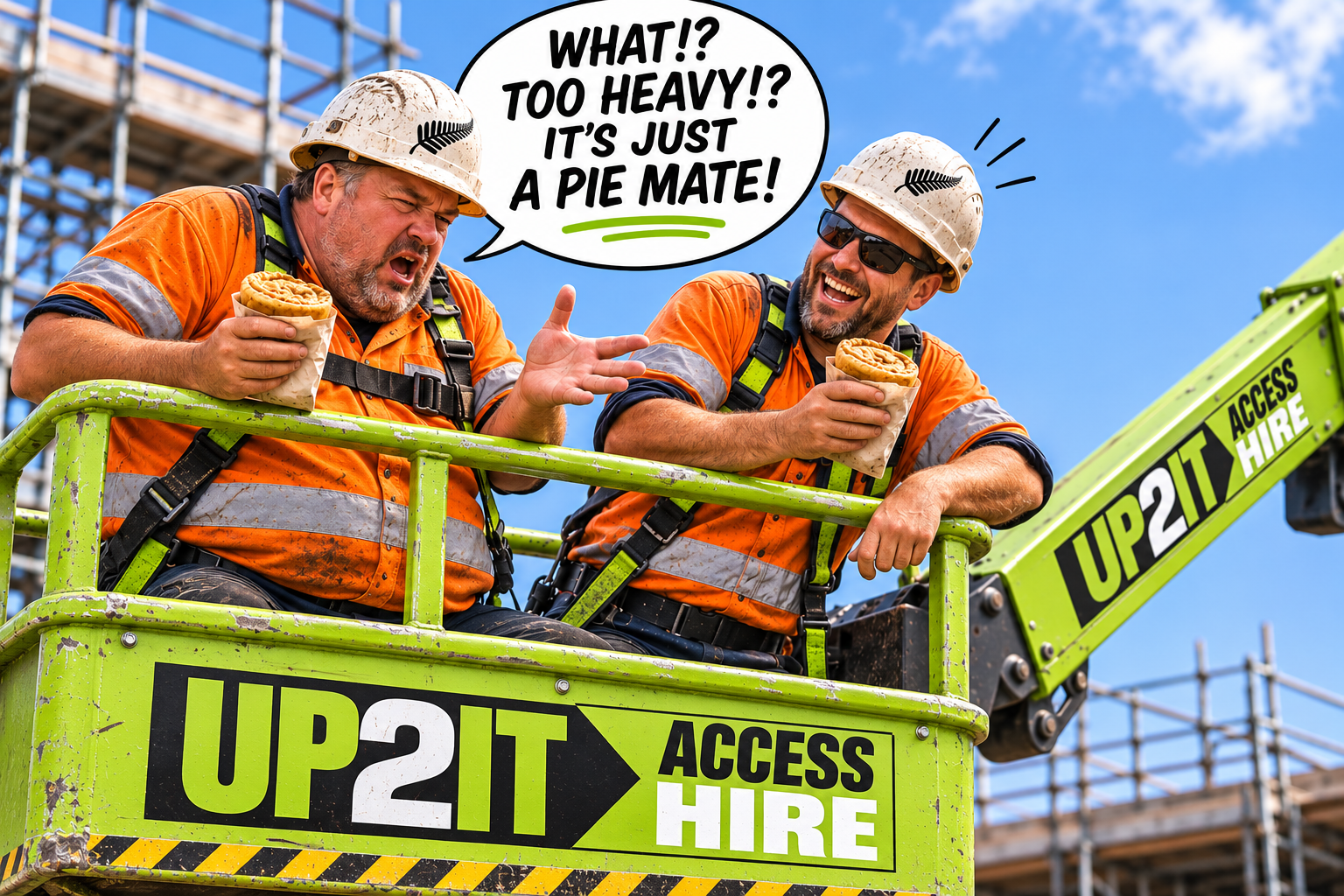
Now put that same person on a scissor lift at 10am in boots, hi-vis, harness and a tool belt that would make Batman jealous, holding a coffee, with a sausage roll on board and a box of fixings at their feet. The platform doesn’t care what the bathroom scale said. It only cares what’s actually on it.
The short version
- Platform limits are lower than most people think. Many small slab scissors are rated around 230 kg in total: people, tools and materials.
- Your “working weight” is your body weight plus 10 to 20 kg of boots, PPE, tools and lunch.
- Two average Kiwi blokes with gear can fill a small scissor before a single sheet of material goes on.
- Extension decks and booms at full reach often have even lower limits.
- Read the decal, do the maths, and send materials up in smaller loads.
This isn’t a diet article, and nobody at UP2IT is in a position to lecture anyone about pies. But the numbers matter. In the 2022/23 New Zealand Health Survey, the average adult man weighed about 88.5 kg for European/Other, 95.6 kg for Māori and 106.9 kg for Pasifika men (Figure.NZ). Construction is a physical job, and plenty of that is muscle. Muscle still counts.
For our sums below, we’ll use a pretty typical site worker: 95 kg. If you’re reading this thinking “that’s not me”, good. Now go and weigh yourself in your work gear.
These are rough, typical weights. Your gear may be lighter, or a lot heavier if you’re the one who carries everything “just in case”.
| Item | Typical weight |
|---|---|
| Steel-cap boots (pair), plus whatever mud you brought from the car park | 2–3 kg |
| Hard hat, hi-vis, safety glasses, gloves, ear muffs | 1–1.5 kg |
| Full body harness and lanyard | 2–3 kg |
| Wet weather gear (or clothes that got rained on at smoko) | 1–2 kg |
| Phone, keys, wallet and the tape measure that lives in your pocket | 0.5–1 kg |
| Dressed for work | About 7–10 kg |
| Item | Typical weight |
|---|---|
| Loaded tool belt or pouch | 5–10 kg |
| Cordless drill, impact driver and a couple of spare batteries | 4–6 kg |
| 1.5 litre water bottle (a litre of water weighs a kilo) | 1.5 kg |
| Flat white, energy drink and a pie or two, currently being digested | 0.5–1 kg |
| The lunch box you didn’t leave in the ute | 1 kg |
| Tools and tucker | About 12–20 kg |
Your real working weight
95 kg body + 8 kg dressed + 15 kg tools and tucker = about 118 kg
That’s 23 kg more than the bathroom scale said, and you haven’t picked up any materials yet.
Materials are where platforms really get overloaded, because nobody weighs them. A few common examples (approximate):
Here’s a normal morning on a small slab scissor rated at 229 kg, a common rating for this size of machine (Skyjack spec sheet):
| On the platform | Weight |
|---|---|
| Tradie 1, dressed, with tools and breakfast on board | 118 kg |
| Tradie 2, a bit lighter but carrying the drill kit | 110 kg |
| Total, before any materials | 228 kg |
| Add one sheet of plasterboard and a box of fixings | + 28 kg |
| Total | 256 kg: 27 kg over |
Nobody on that platform would say they were overloading it. They’d say “there’s two of us and one sheet of gib”. That’s exactly the problem.
Why it matters (the serious bit)
Overloading reduces the machine’s stability margin. On a scissor that can mean tipping on a slope or in a gust. On a boom it can mean tipping at full reach. Overloaded platforms also stress the structure, hydraulics and brakes, which shortens the machine’s life and can lead to failures.
Many modern machines have an overload sensor that stops the platform working if there’s too much weight on it. If the alarm goes off, it’s not broken. It’s telling you the truth. Don’t try to beat it.
☐ Platform capacity read off the decal
☐ Extension deck limit checked if you’re using it
☐ Number of people within the indoor/outdoor rating
☐ Each person’s working weight estimated, including gear
☐ Materials weighed or checked against supplier data
☐ Load spread evenly, heavy items low and central
☐ Boom loaded for the outreach zone you’ll work in
☐ Unneeded tools, food and gear left on the ground
Need more capacity?
UP2IT Access Hire supplies serviced, certified small and large slab scissors, rough terrain scissors and booms across Auckland from our Penrose depot, delivered on our own trucks. Tell us how many people are going up, what they’re taking with them and how high they need to go, and we’ll match a machine with the capacity to suit. We also offer free site inspections and EWP operator training.
Weights in this article are typical estimates for illustration. Always use the capacity on your machine’s decal and in the manufacturer’s operating manual, and follow your site safety plan and current WorkSafe NZ guidance.