
273a Church St, Onehunga, Auckland, Auckland
By Christopher Green, UP2IT Access Hire · 16 October 2026 · 7 min read
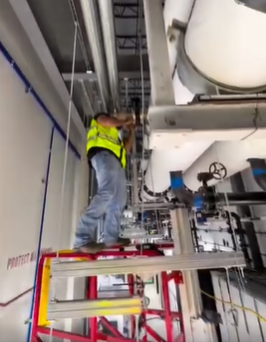
Most construction sites already ban standing on scissor lift guardrails. Operators sign the induction, the rule is in the SWMS, and there’s a sticker on the platform. Walk the floor for an hour, though, and you’ll probably still see someone with a boot on the mid-rail reaching for that last fixing.
That’s because rail climbing is usually a symptom, not the problem. People rarely climb because they don’t know the rule. They climb because, at that moment, the machine, the site or the schedule makes climbing look like the only way to finish the job. Fix those causes and the climbing mostly stops.
Why it matters
The guardrails are the platform’s primary fall protection. Step on them and you’ve stepped outside the protected envelope, often 4 to 10 metres above a concrete slab. IPAF’s accident data lists standing on guardrails as one of the main ways people fall from platforms, and falls from the platform are almost always fatal or seriously injuring (IPAF).
This short clip shows exactly the behaviour we’re talking about: a worker climbing onto the guardrail of a scissor lift with no harness.
Video: Fire Sprinklers Pro (watch on Facebook).
The short version
- Plan for the highest point of the work, not the ceiling height, and hire a machine that gets the operator there comfortably.
- Clear the floor so the platform can get right up to the work.
- Make repositioning quick and normal, not something that costs a crew time or money.
- Have enough machines so nobody is making do with the wrong one.
- When you see someone on the rails, stop the job and ask why they couldn’t reach. Then fix that cause the same day.
Ask any crew and they’ll tell you. These are the causes we see most often on Auckland sites.
| Cause | What it looks like on site |
|---|---|
| Machine too short | The lift tops out just below the work. Ceiling services, bulkheads, the top of a wall or a high fixing line are a little out of reach, so the operator steps up. |
| Can’t get close enough | Pallets, offcuts, trenches, other trades’ gear or a slab edge keep the platform back from the work. The gap gets closed by leaning or climbing. |
| Work is over an obstacle | Pipework, ducts or a ceiling grid sit between the platform and the work. A scissor only goes straight up, so the operator climbs to reach over. |
| Repositioning is a hassle | Lowering, moving and raising again takes a few minutes each time. On a long run of fixings, climbing to reach one more looks quicker. |
| Time and money pressure | $/hour, tight programmes or a supervisor pushing for production all reward the shortcut. |
| Not enough machines | One lift shared between trades. Whoever has it uses it for everything, even work it isn’t tall enough for. |
| Props on the platform | Buckets, boxes, step ladders or material stacks on the deck give people something to stand on, and the rail is the next step. |
| Culture and habit | Everyone does it, nothing happens, and supervisors walk past. It becomes normal. |
Why paperwork alone doesn’t work
A signed rule sheet tells you the operator knew the rule. It doesn’t change any of the reasons in the table above. Under the Health and Safety at Work Act 2015, the business running the site still has to provide suitable plant, a safe system of work and adequate supervision. WorkSafe lists inadequate supervision and not fully assessing the job, site and equipment among the common causes it finds when it investigates scissor lift injuries (WorkSafe NZ).
This is the biggest single fix. Machines are often picked by the ceiling height or the drawings rather than by where the operator actually needs to put their hands.
Rail climbing happens out of sight, at height, when the supervisor is somewhere else. It needs active supervision, not a rule on the wall.
What about harnesses?
Guardrails are accepted fall protection, but they aren’t perfect: a person can still go over the top rail or through the gap below the mid-rail. That’s why some safety professionals argue for a primary and a secondary layer of protection on scissor lifts.
Use restraint, not arrest. On a scissor lift, a harness clipped to the platform’s marked anchor point with a short restraint lanyard can stop the operator reaching or climbing onto the top rail. Fall arrest is a different story: a self-retracting lifeline needs roughly 1.4 m of clearance and an energy-absorbing lanyard can need over 5 m. At typical scissor working heights, a person could hit the ground before an arrest system catches them.
Use the right anchor. Clip only to the anchor point marked on the machine. A guardrail may not be strong enough to act as an anchor, and many scissor anchors are rated for restraint only. Check the manual and decals.
A harness is never permission to stand on the rails.
Run through this at the start of each stage of work.
☐ Highest point of the work identified for each trade
☐ Machine height chosen so the work is at chest to shoulder height
☐ Up-and-over work allocated to a boom, not a scissor
☐ Enough lifts on site for the number of trades needing access
☐ Access routes and work areas clear for the platform
☐ Operators trained and familiarised, including the extension deck and drive-at-height
☐ Repositioning built into the programme and the price
☐ No buckets, ladders or stacks on platforms; rails on and gates shut
☐ Supervisors checking platforms on every walk-around
☐ Rail climbing recorded as a near miss and the cause fixed
Need the right height, or EWP training?
UP2IT Access Hire supplies serviced, certified scissor lifts and booms across Auckland from our Penrose depot, delivered on our own trucks. Tell us the highest point of the work and what’s in the way, and we’ll match the right machine. We also offer free site inspections, and EWP operator training on your site or in our classrooms.
This guide is general information only. Always follow the manufacturer’s operating manual, your site safety plan and current WorkSafe NZ guidance.